# LK-99
> Markdown version of https://brajeshwar.com/2023/LK-99/ — 2023-08-16
LK-99 recently became a notorious topic alongside AI, UFOs with non-biological components, for its superconductivity property. [LK-99](https://en.wikipedia.org/wiki/LK-99) is a gray–black, polycrystalline compound, identified as a copper-doped lead‒oxyapatite.
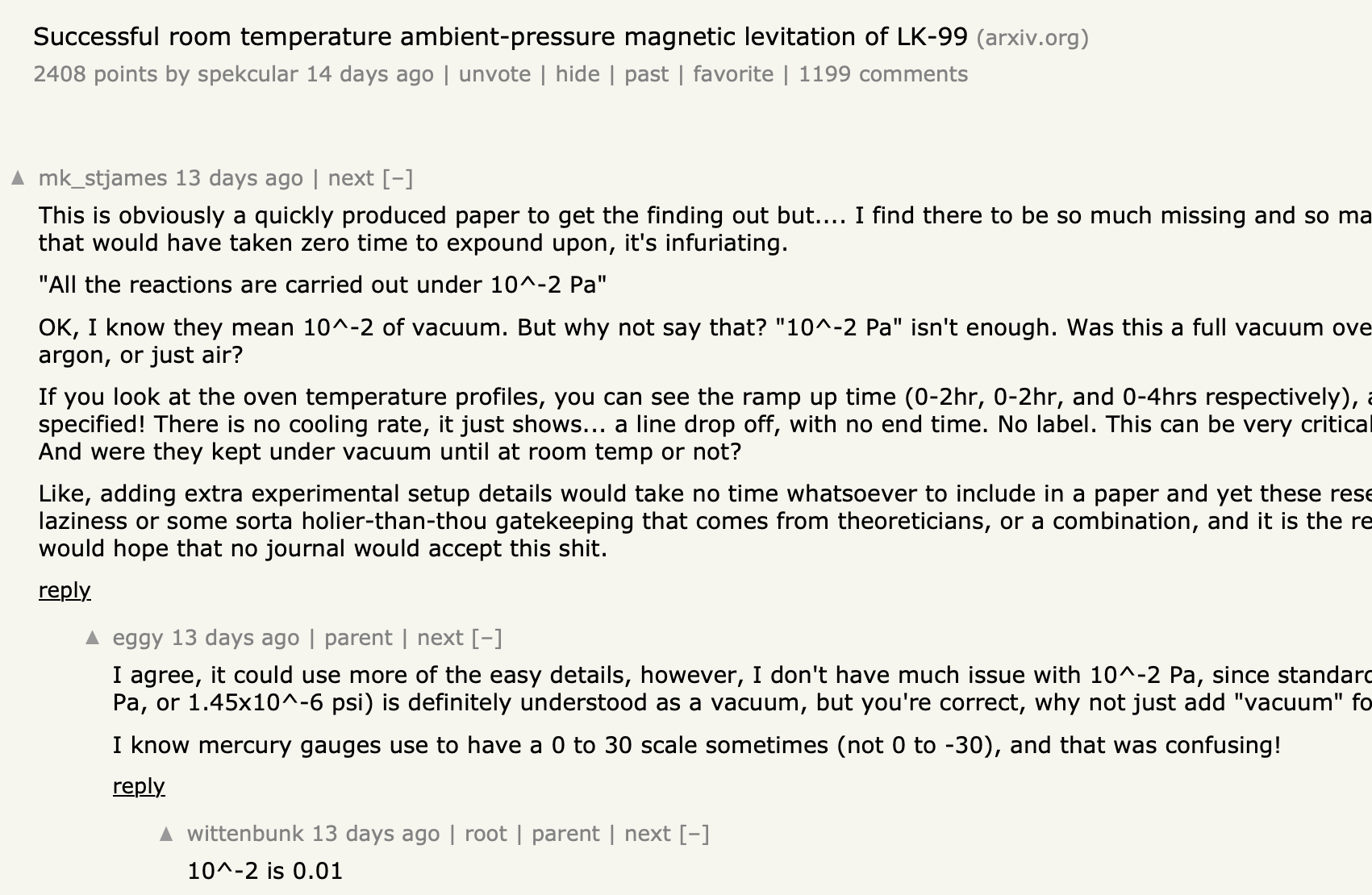
HackerNews discussion on Successful room temperature ambient-pressure magnetic levitation of LK-99.
On Aug 2, 2023, preprints were [published on arXiv](https://arxiv.org/abs/2308.01516) (an open-access preprint archive), claiming that it acts as a room-temperature superconductor at temperatures of up to 400K (127 °C; 260 °F) at ambient pressure.
The Internet went wild with everything else happening around. On Aug 16, 2023, Nature published an article on how scientists solved the mystery — [LK-99 isn’t a Superconductor](https://www.nature.com/articles/d41586-023-02585-7).
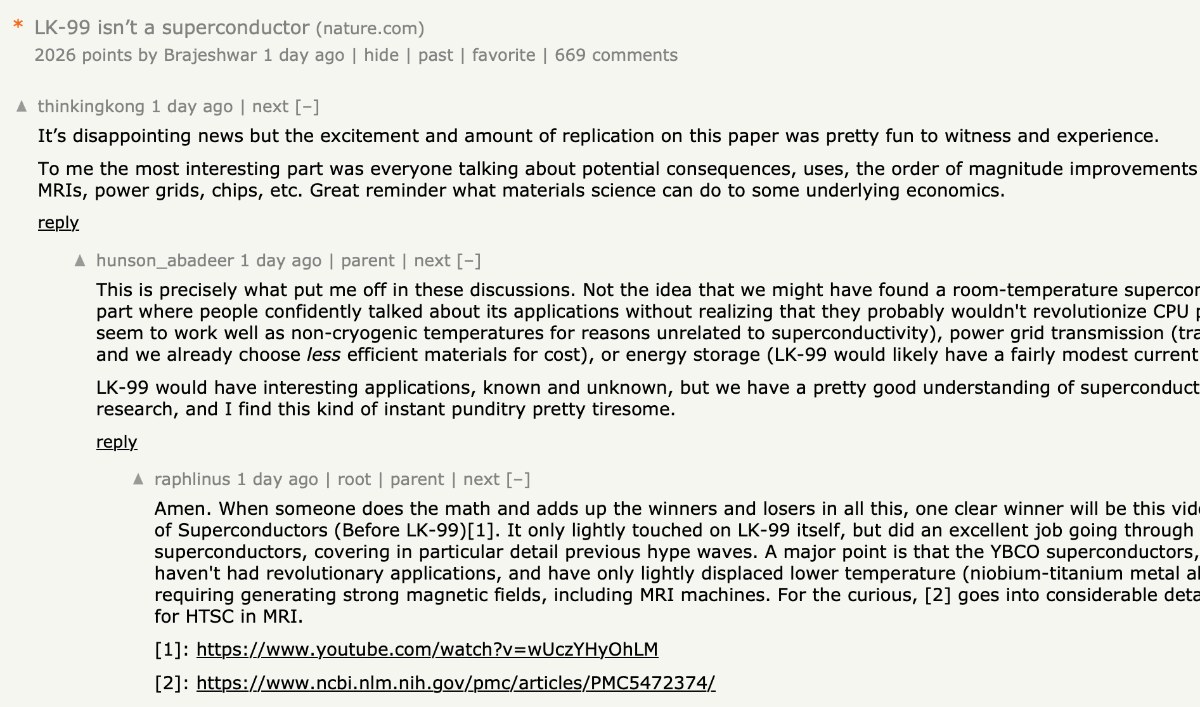
HackerNews discussion when LK-99 isn’t a Superconductor.
> The conclusion dashes hopes that LK-99 — a compound of copper, lead, phosphorus and oxygen — marked the discovery of the first superconductor that works at room temperature and ambient pressure. Instead, studies have shown that impurities in the material — in particular, copper sulfide — were responsible for the sharp drops in electrical resistivity and partial levitation over a magnet, which looked similar to properties exhibited by superconductors.