Mathematics in Design: Nature’s Formula for Beauty
A few weeks back, I saw my daughter sketching a character for her schools’ event, some sort of a India-Japan collaboration. She has a natural gift for creativity, the kind of talent that lets her draw fluidly without overthinking proportion or spacing. I watched her with quiet admiration. When I tried to explain why some of her shapes “felt right” and why others looked slightly off, I found myself reaching for mathematics, not art theory.
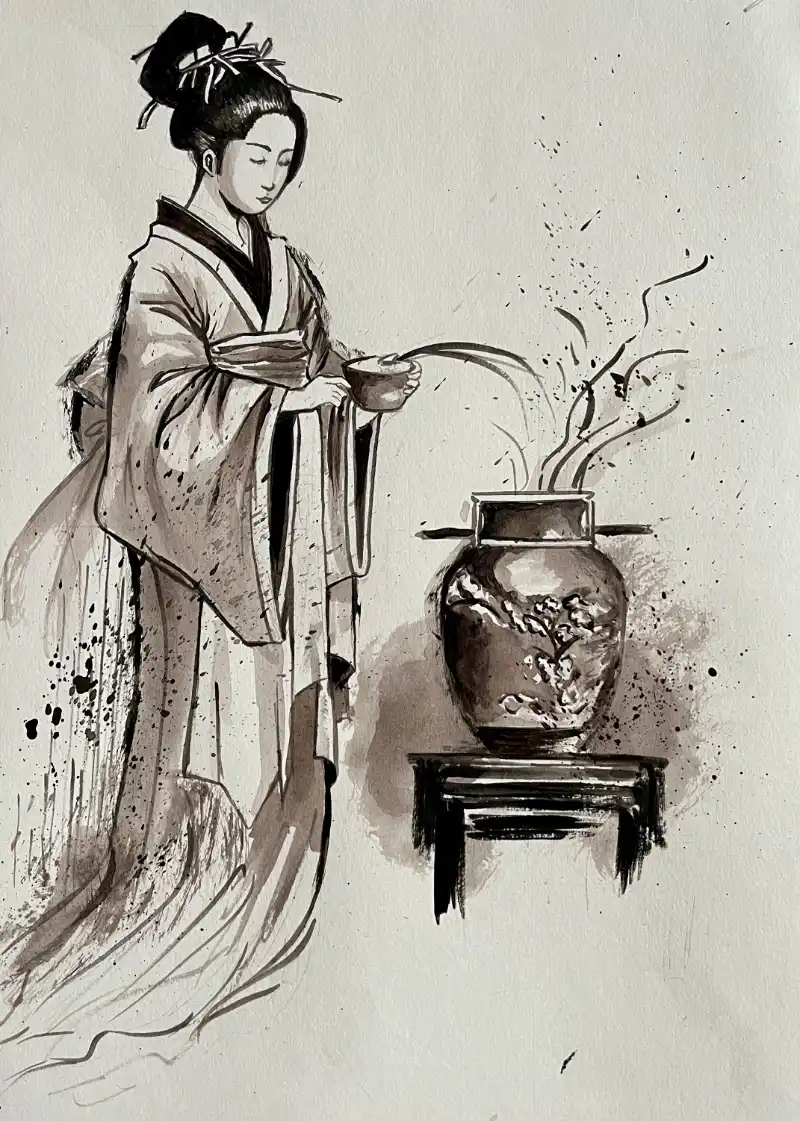
I told her the story of how I started as a designer. When I began my career as a developer, there were no designers in the room. We built products with bare bones. Design wasn’t even an afterthought; heck, it was nonexistent. Out of necessity, I picked up design. As a developer, my first tools were not brushes or palettes. They were numbers, ratios, and patterns.
I explained to her that Math helped me become a designer. I explained that much of what we perceive as “beautiful” in art or design is underpinned by proportion, geometry, and invisible formulas. She paused, then redrew one of her characters with a slightly adjusted frame. It looked balanced. She nodded without admitting I was right.
Mathematics is not cold or detached from creativity. It is often the hidden rhythm of beauty.
The Old Masters Knew the Numbers
This is not a modern discovery. Leonardo da Vinci’s notebooks are filled with sketches that reveal an obsession with proportion. His famous Vitruvian Man is not just an artistic experiment. It is an illustration of mathematical ratios guiding the human body, echoing Vitruvius, the Roman architect who believed buildings should reflect human proportions.
The Renaissance itself was a revival of order, symmetry, and proportion. Artists and architects rediscovered that math could guide the hand as much as the eye. Luca Pacioli’s treatise Divine Proportion became da Vinci’s companion text, marrying theology, art, and mathematics into a single philosophy of beauty.
The Egyptians, long before them, employed geometric precision to align their pyramids with the stars. The Greeks studied harmony in music and applied the same numerical thinking to temples. Even Islamic architecture, with its elaborate mosaics, is characterized by the repetition of geometric patterns.
What these traditions share is not just an aesthetic. They reveal a trust, “Beauty is Measurable.”

Fibonacci and the Golden Ratio
The Fibonacci sequence, 1, 1, 2, 3, 5, 8, 13, looks like a child’s game of addition, yet its spiral appears everywhere in nature. The florets of a sunflower, the swirl of a hurricane, the chamber of a nautilus shell: each arranges itself following this quiet logic.
Designers borrow this sequence to create proportions that “feel natural.” Overlay the spiral on an Apple logo, Twitter’s bird, or a well-designed website, and you’ll often find alignment. Product dimensions, like the first iPod’s click wheel, echo similar spirals.
Closely linked is the Golden Ratio, approximately 1.618. Architects and painters have claimed it as a blueprint for balance. The Parthenon’s facade is said to embody it. Da Vinci’s Mona Lisa allegedly hides it. Le Corbusier, the modernist architect, designed his Modulor system around it, believing that human scale and comfort lived within its bounds.
Of course, not every claim is valid. Many Golden Ratio stories are myths that have been retrofitted by overzealous aesthetes. But whether literal or metaphorical, the ratio represents a truth: humans gravitate toward specific proportions because they echo what we already encounter in nature.
Symmetry and Balance: The Psychology of Pleasing
Our brains are wired for symmetry. Studies in psychology show that we perceive symmetrical faces as more attractive, even if the differences are imperceptible. Evolution trained us to recognize balance as a sign of health, fertility, and safety.
Designers leverage this instinct. Gothic cathedrals achieve grandeur through mirrored balance. Islamic art employs symmetry to convey the concept of infinity. Bauhaus distilled geometry into clean, balanced forms that still define modern minimalism.
Even in digital design, we rely on invisible grids to maintain structural balance. Responsive frameworks, such as Bootstrap and CSS grids, are mathematical systems that ensure order across screens. Typography rests on baselines and x-heights, each number precisely chosen. A poster layout, when stripped of color, reveals itself as a geometry problem.
Math doesn’t limit creativity; it holds it steady.
The Mathematics of Motion
Static proportion is only one half of the design story. Motion is also mathematics.
Every digital animation you encounter relies on equations. Bézier curves, named after French engineer Pierre Bézier, describe the elegant arcs in typefaces, vector graphics, and animation software. Without them, fonts would look jagged, and animations would be stiff.
The easing functions that make an interface “feel smooth”, the way a panel slides into view or a bouncing ball slows before settling, are all mathematical formulas. Ease-in, ease-out, and cubic-bezier are all invisible to users, but essential for believability.
Even the way a website scales between desktop and mobile is proportional math. Ratios dictate whether an image shrinks gracefully or distorts. Motion design is less about pixels and more about predicting how numbers change over time.
Math makes interactions feel alive.
Generative Design: Algorithms as Co-Creators
Today, mathematics has taken on a more direct role in design, creating new possibilities.
Generative art relies on algorithms to produce patterns that surpass what the human hand can create. Fractals, such as the Mandelbrot set, reveal endless complexity from simple equations. Architects like Zaha Hadid pioneered parametric design, a style that utilizes formulas to bend steel and concrete into previously unimaginable forms.
In video games, entire landscapes are procedurally generated through mathematical rules. Mountains, rivers, and even trees emerge from code, not handcrafted.
AI tools extend this further. What we call “creativity” in generative AI is, under the hood, optimization and probability, mathematics iterating through possibilities. Designers are learning to guide algorithms as much as they guide pencils.
Far from killing creativity, math is becoming its collaborator.
Why the Brain Loves Numbers in Disguise
Why do these ratios, grids, and patterns matter? Because our brains are pattern machines. Gestalt psychology shows how we instinctively group shapes, perceive continuity, and complete gaps. Rhythm comforts us. Repetition builds memory. Balance signals harmony.
Even chaos works when structured mathematically. Jazz improvisation follows strict timing. Abstract art often hides deliberate ratios. What seems random is rarely without hidden order.
This is why design “feels” right when math supports it. We may not articulate it, but we sense the structure.
Returning to that day with my daughter, I realized she already had what I lacked as a young developer: natural artistic instinct. What she doesn’t yet see is how numbers can amplify her art. A circle drawn freehand becomes more convincing when guided by geometry. A layout that feels playful can also be mathematically sound.
I told her, “Art without structure may charm, but design that lasts often rests on math.” My path was from Math to Art. Hers may be art, but with enhancements from math. Both roads converge.
The Renaissance masters knew it. Modern brands practice it. Our brains crave it. Whether by Fibonacci spirals or Bézier curves, mathematics is nature’s whisper inside design.
Nature’s Signature, Human Hands
Designers do not invent harmony. We uncover it. Nature already solved the riddle through ratios, spirals, and symmetry. Math is the language of those solutions.
When we align our work with those principles, we tap into something timeless. Whether building a cathedral, sketching a character, or coding a website, the designer’s role is translation, taking invisible formulas and shaping them into visible beauty.
And perhaps, years from now, my daughter will remember that lesson: that behind every sketch lies a quiet equation. That beauty, far from being mysterious, is often measurable.