Ode on a Grecian Urn - Beauty is Truth, Truth Beauty
When I first encountered John Keats’ Ode on a Grecian Urn, it was not in some hushed library or with the usual teacher’s lecture but in a sun-baked classroom, where the walls were scribbled with chalk dust and the clock seemed to linger out of mercy for restless students. The poem came to me as an assignment, a duty, a lesson to be endured rather than savored. Our teacher read the lines aloud with a gravity far greater than my thirteen-year-old heart could bear. I was half-listening, half-dreaming, caught between the pages of the anthology and the girl seven rows ahead who wore her hair like a crown of casual rebellion.
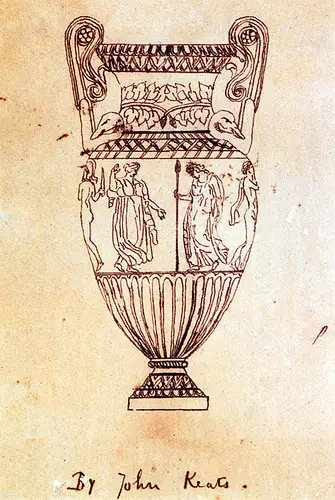
Back then, the urn meant nothing to me. A pot, a relic, frozen dancers etched in stone. However, I remember the pulse leapt at the brush of a hand when passing a notebook, or whose heart drummed louder than Keats’ syllables when a first kiss seemed possible? In those days, truth and beauty were not philosophical pursuits; they were the stolen moments behind the library shelves, the laughter shared on the bicycle ride home, the heat of friendship in a world still unshaped by responsibility.
And yet, the lines stayed. Even when I forgot the shape of the stanza, I remembered the final couplet. “Beauty is Truth, Truth Beauty,” that is all you know on earth, and all ye need to know. At the time, it felt like a riddle left unsolved. I carried it like one carries a pebble in the pocket, aware of its presence, waiting for the right day to turn it over in the hand.
Now, when I return to those words, they no longer speak to me as abstractions. They return as a lens through which I see my own youth, forever alive, forever untouchable. My friends from those days have scattered, grown older, and some have lost, been shaped by the loves and losses of their own. The girl with the careless hair is no longer the same, nor am I. Yet in memory, we remain unchanging, caught like the figures on Keats’ urn, always just before the music stops, always just before the kiss lands.
What once struck me as stillness now feels like eternity. The urn is no longer lifeless but alive with the paradox of permanence. Those frozen dancers are every laugh that still rings in my ears, though decades have passed. Those carved lovers are every stolen glance that once set fire to a shy heart. The urn has become my schooldays, held forever in an embrace of memory, never fading, never fulfilled, consistently enough and never enough.
Keats teaches us to linger. He gazes into the urn with the same insistence with which I now gaze into the windows of my past. What once seemed trivial now feels like the essence of life, the ability to hold beauty, if only in the mind, and to believe that in doing so, one brushes against truth.
So the poem has changed, or rather, I have. The boy who once copied the lines into a notebook with more ink on his hands than understanding in his head could not have known what the man would see. At the time, the poem was a school assignment. Now, it is memory’s companion. The urn is no longer marble but time itself.
And perhaps that is the secret folded within those famous words. Beauty is Truth because memory makes it eternal. Truth is Beauty because it returns to us, unbidden, in the scent of chalk dust, in the tremor of a first kiss, in the lines of a poem we first read when we were too young to understand and too alive to care.
Thou still unravish’d bride of quietness,
	Thou foster-child of silence and slow time,
Sylvan historian, who canst thus express
	A flowery tale more sweetly than our rhyme:
What leaf-fring’d legend haunts about thy shape
	Of deities or mortals, or of both,
		In Tempe or the dales of Arcady?
	What men or gods are these? What maidens loth?
What mad pursuit? What struggle to escape?
		What pipes and timbrels? What wild ecstasy?

Heard melodies are sweet, but those unheard
	Are sweeter; therefore, ye soft pipes, play on;
Not to the sensual ear, but, more endear’d,
	Pipe to the spirit ditties of no tone:
Fair youth, beneath the trees, thou canst not leave
	Thy song, nor ever can those trees be bare;
		Bold Lover, never, never canst thou kiss,
Though winning near the goal yet, do not grieve;
	She cannot fade, though thou hast not thy bliss,
		For ever wilt thou love, and she be fair!

Ah, happy, happy boughs! that cannot shed
	Your leaves, nor ever bid the Spring adieu;
And, happy melodist, unwearied,
	For ever piping songs for ever new;
More happy love! more happy, happy love!
	For ever warm and still to be enjoy’d,
		For ever panting, and for ever young;
All breathing human passion far above,
	That leaves a heart high-sorrowful and cloy’d,
		A burning forehead, and a parching tongue.

Who are these coming to the sacrifice?
	To what green altar, O mysterious priest,
Lead’st thou that heifer lowing at the skies,
	And all her silken flanks with garlands drest?
What little town by river or sea shore,
	Or mountain-built with peaceful citadel,
		Is emptied of this folk, this pious morn?
And, little town, thy streets for evermore
	Will silent be; and not a soul to tell
		Why thou art desolate, can e’er return.

O Attic shape! Fair attitude! with brede
	Of marble men and maidens overwrought,
With forest branches and the trodden weed;
	Thou, silent form, dost tease us out of thought
As doth eternity: Cold Pastoral!
	When old age shall this generation waste,
		Thou shalt remain, in midst of other woe
Than ours, a friend to man, to whom thou say’st,
	“Beauty is truth, truth beauty,—that is all
		Ye know on earth, and all ye need to know.”