10x is Easier Than 2x
Ten times the result, and less work than doubling. I read 10x Is Easier Than 2x by Dan Sullivan and Benjamin Hardy1 expecting motivational multipliers but got something of an argument about subtraction.
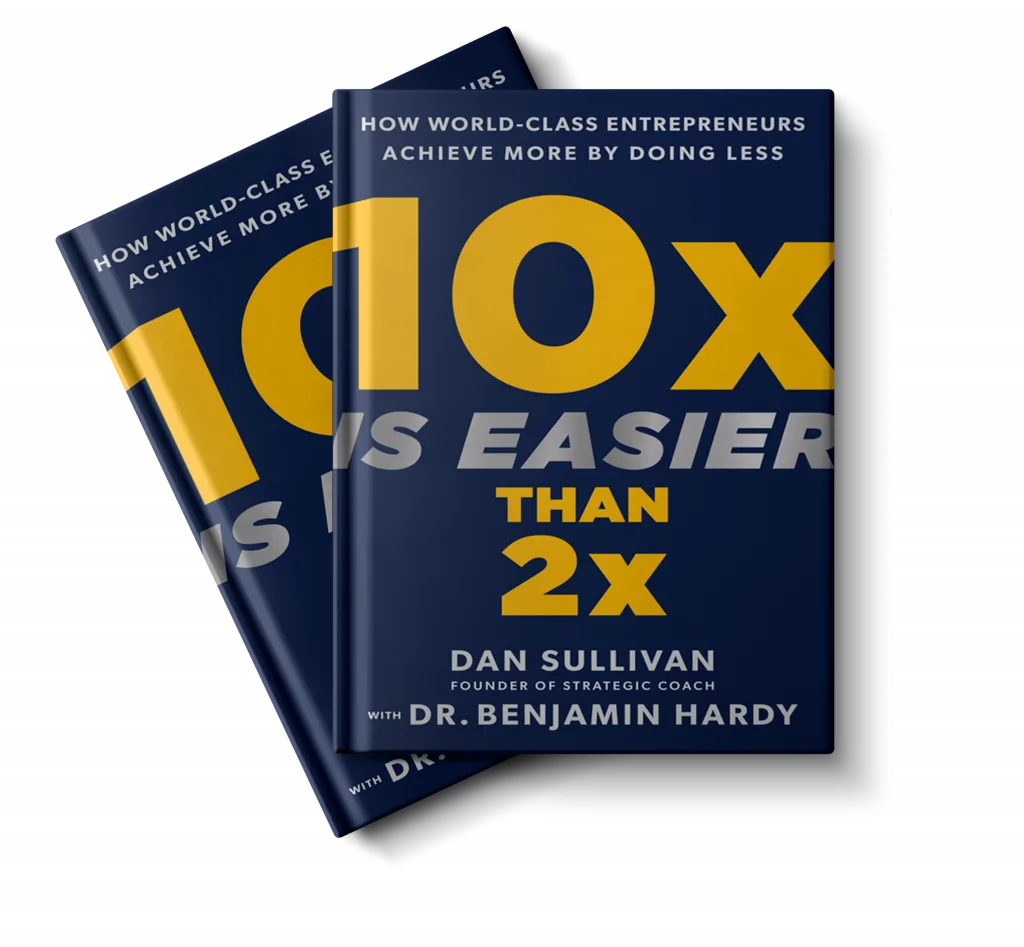
You can reach 2x by doing more of what you already do. More clients, more hours, more of the same. It is a volume problem, and effort solves volume problems. That is why 2x is exhausting rather than difficult.
10x will not yield to volume. Nothing you are currently doing, done harder, gets you there. The only route left is to work out which fifth of your work produces nearly all of the result, and to let the other four fifths go.
This book is the Pareto Principle2, applied over and over. Each jump keeps the 20% and discards the rest, and the 20% you kept becomes the entire field for the next round. The book’s favorite image is Michelangelo in front of a block of marble, removing everything that is not the statue.
“How do we grow 20% next year” returns a list of things you are already doing with slightly larger figures beside them. “What would have to be true for this to be ten times bigger” returns a different list, and most of it is things you would have to stop.
This is why the honest answer to “can we also do X” is so often no. Not because X is bad, but because the list is the product.
I have watched this play out in product reviews for years. Ask a team to improve a feature and they will polish it. Ask them what the product would look like if it did a tenth as much and mattered ten times more, and the meeting stops being about the feature and becomes an argument about what the product is for.
Be warned; this is a Strategic Coach book, and it carries the house vocabulary. Unique Ability, Who Not How, the Gap, and the Gain. Each idea arrives with its capital letters and a client testimonial attached, and if you have read Sullivan’s earlier books you will meet all of them again here, at length.
The examples are also, every one of them, people who made it. Nobody in these pages drops eighty percent of their clients and ends up worse off, which is not the same as nobody ever having done so. Every book in this genre has a survivorship problem.
And “easier” is carrying a great deal of weight in that title. 10x is not easier. It is differently hard, over a much smaller surface, with far more variance. What the book means is that 10x is easier to see, because the goal is so far out of reach that it eliminates most of your options for you.
There is a freedom being assumed, too. Letting go of most of your clients is a founder’s move, and it takes runway, or a partner, or twenty years of reputation to fall back on. From inside a job, with a mortgage, the advice needs translating before it can be used.
Two Things
The first is that constraints clarify. A target you cannot reach by working harder forces you to say out loud what you actually believe produces the result. Most of us have never had to say it out loud.
The second is that subtraction is a decision, and it is the one nobody schedules. We plan what to add every quarter. I have sat in very few meetings called to decide what to stop.
You can read this one inspectionally3 in an afternoon and lose nothing. The argument is in the first third; the rest is the same argument with more customers in it.
-
The Pareto principle holds that roughly 80% of the outcomes come from 20% of the causes. It is named for Vilfredo Pareto, who noticed in 1896 that about twenty percent of Italians owned about eighty percent of the land. Pareto observed the distribution. He did not suggest you apply it to yourself, recursively, forever. ↩
-
Systematic skimming, and a real skill rather than cheating. See How to Read a Book. ↩